
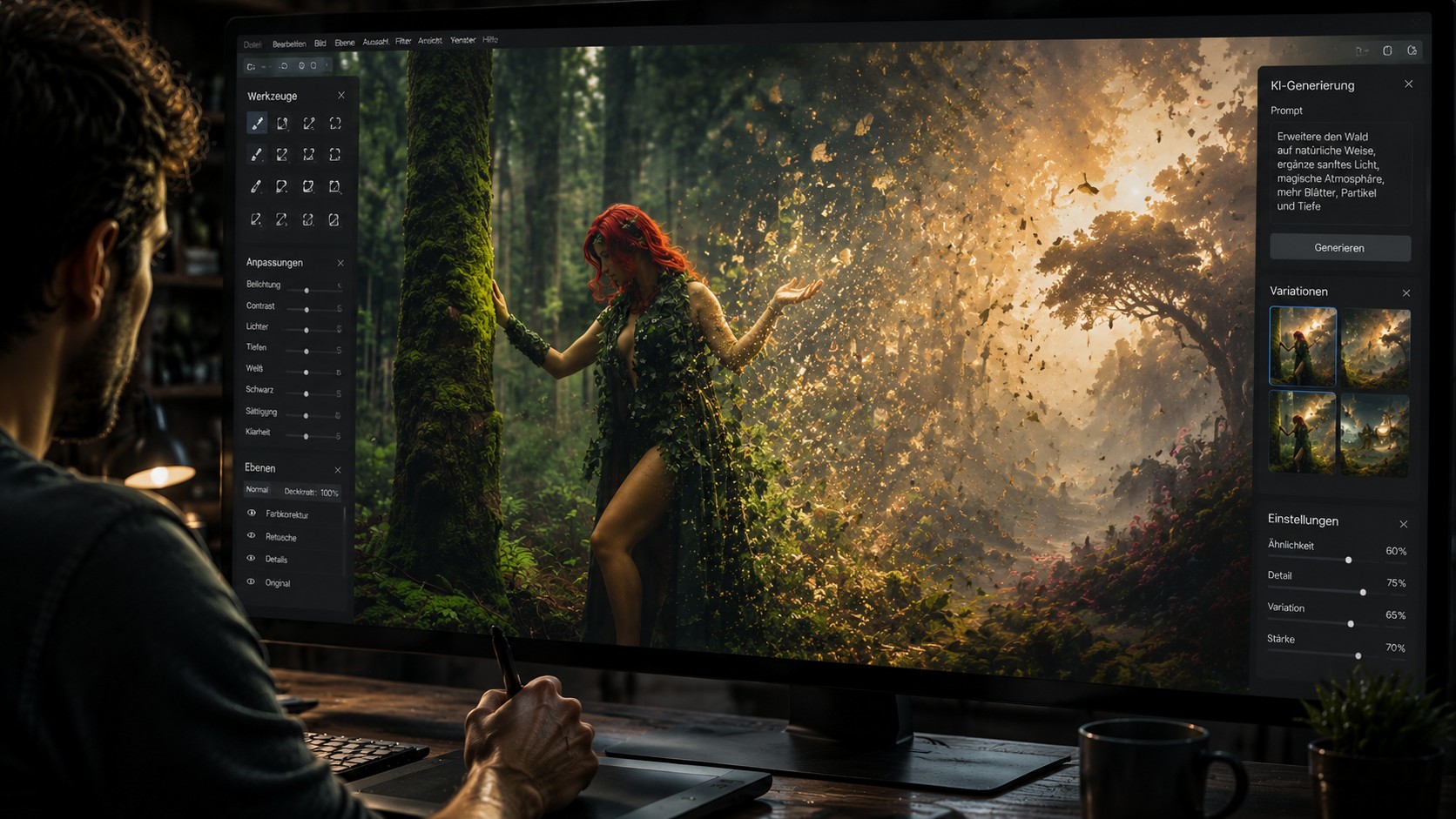
AI in photo editing – Tool or loss of control?
Michael Light · July 23rd 2026 · Photoshop, AI
When is AI more than just a tool?
Mention “AI” and “photo editing” in the same sentence and opinions diverge – fast. The topic is so multifaceted that a simple yes or no doesn’t really do it justice. Anyone who starts unpacking the arguments will sooner or later inevitably come up with copyright – or the catastrophic environmental footprint that AI models leave behind. Both concerns are absolutely valid, both are absolutely important, and for most people they’re immediately the absolute dealbreaker. Even so, I’m deliberately leaving both out of this article – if only because it would otherwise be over after this paragraph.
Alternatively, one could of course launch into a discussion about the energy consumption of home PCs compared to the optimised performance of a data centre – factoring in time savings depending on task complexity, naturally. Or about the subtle ethical differences between various training models and their licensing issues. Honestly – who wants to read that? It’s either mind-numbingly boring or pure ragebait. I’d like to spare us both.
What I actually want to talk about is something entirely different – what can AI actually do in photo editing – and at what point does the artist become less of an artist and more of a conductor? An architect? A director? Somewhere between “I’m editing my image” and “I’m describing what I have in mind” there’s a line. Where exactly – that’s the genuinely interesting question.
Recently I ran a poll in my small Instagram community, and the result was pretty clear: just 1% are enthusiastic about AI in photo editing. Two thirds find AI acceptable for minor corrections but firmly reject generative AI, while the remaining third rejects the use of AI in their images entirely. Interestingly, it’s precisely those “minor corrections” that so many people still let slide that I personally find quite critical – but more on that later.
Somewhere between “I’m editing my image” and “I’m describing what I have in mind” there’s a line.
And that raises another question: how representative are these numbers anyway? How many of the people who took part have genuinely engaged with the topic? Who knows Photoshop well enough to judge where AI actually makes sense – and which tasks have long been solvable with built-in tools? Opinions form quickly, especially when headlines are making the rounds or the general mood is pulling in a particular direction. That’s not a criticism – it’s human, but it’s exactly why I’d like to approach this topic as neutrally as possible.
AI where classic tools hit their limits
Before we talk about what AI can do and where it makes sense, let’s start at the other end. Specifically, where AI in my opinion simply doesn’t belong – and that brings us to the much-loved “minor corrections”. As a rule, minor corrections are precisely the point at which using AI is like using a sledgehammer to crack a nut. A simple colour correction here, removing a distracting object there – Photoshop has been doing that in its sleep for years. You don’t need AI for that. Anyone reaching for AI to do a basic white balance or curves adjustment has probably been watching too many YouTube videos. AI makes sense where classic tools hit their limits – not as a replacement for what Photoshop can already do.
Of course, the devil is always in the details. A good example is the classic hair tie on the wrist. Anyone who’s read my article on shooting preparation knows: paying attention beforehand is always the better solution. But let’s assume we didn’t, and now we need to fix it. Simple enough, right? Rough selection, content-aware fill, maybe a few corrective clicks with the healing brush – done. No AI needed, just what Photoshop offers out of the box. But how does it look when that same hair tie is sitting on a tattoo, patterned fabric, or a complex texture? That’s where classic retouching quickly runs out of road – and that’s exactly where AI makes a difference. Not because it’s cooler, but because it genuinely solves the problem better and, above all, much faster.
In my own workflow I use AI very sparingly and extremely selectively. Noise reduction, sharpening, or upscaling images – these are areas where you used to have to live with unsatisfying compromises. Anyone who’s tried to enlarge an image without quality loss knows how frustrating that used to be. When you look at what AI delivers today, it’s honestly quite remarkable.
Extending the background is also an absolute game changer for me. How often do you catch a model at the perfect moment – hair flowing in the wind, the expression just right, the focus pin-sharp on the eye – only to realise you got the crop wrong and there’s simply not enough background where you need it, and it can’t be fixed by partial scaling, say for perspective reasons. In the old days you’d be grateful if you had a similar shot with a bit more background and could merge the two with some effort. Today you drag the canvas out until the crop works, and the background fills in almost instantly.
Another example from my day-to-day retouching is a classic from the cosplay world: the wig hairline at the forehead. Sometimes unnaturally straight, sometimes the underlying mesh is still half-visible. That used to mean painstaking work – painting individual hairs by hand to hide the transitions. Today: make a selection, one click, wait a few seconds. Done.
From correction to creation
“AI in photo editing” isn’t one single thing. The range runs from barely noticeable to complete handover – and with it, the question of how much creative control you still actually have.
Strictly speaking, drawing a distinction between generative AI and, say, removing an object is a bit nonsensical. The AI doesn’t remove the object – it regenerates that area of the image without it. Technically, it’s the same thing either way. But let’s allow the thought for a moment and look at them separately from an artistic perspective. When you stay within the realm of corrections and technical improvements, I think we can all agree that you’re still the one creating the art. I decide what happens – the AI does the manual work. When extending backgrounds or swapping out a sky, I’m already bringing things into the image that were never there. I set the creative direction, the AI fills it in. It goes considerably further with prompting entire image transformations or generating whole scenes. Here I’m becoming more conductor than musician – I describe what I have in mind, the AI executes it, and just like that an image exists. No shoot, no subject, no light I set, no moment I captured – just a prompt. Here the AI has taken the wheel entirely.
What is still art?
Let’s stick with a cosplay example and take something pretty much everyone knows – Star Wars. The purest solution from a photographic craft perspective is, of course: find a real location and photograph everything yourself. My research suggests the chances of finding a Star Destroyer, battle droids, or similar objects anywhere near where I live are relatively slim. Which leaves the option you’ve seen countless times – we play the “outdoor mission” card. With the right angle, the right depth of field and a bit of imagination, any location can quickly become a Rebel base. Nobody would question the artistic merit here.
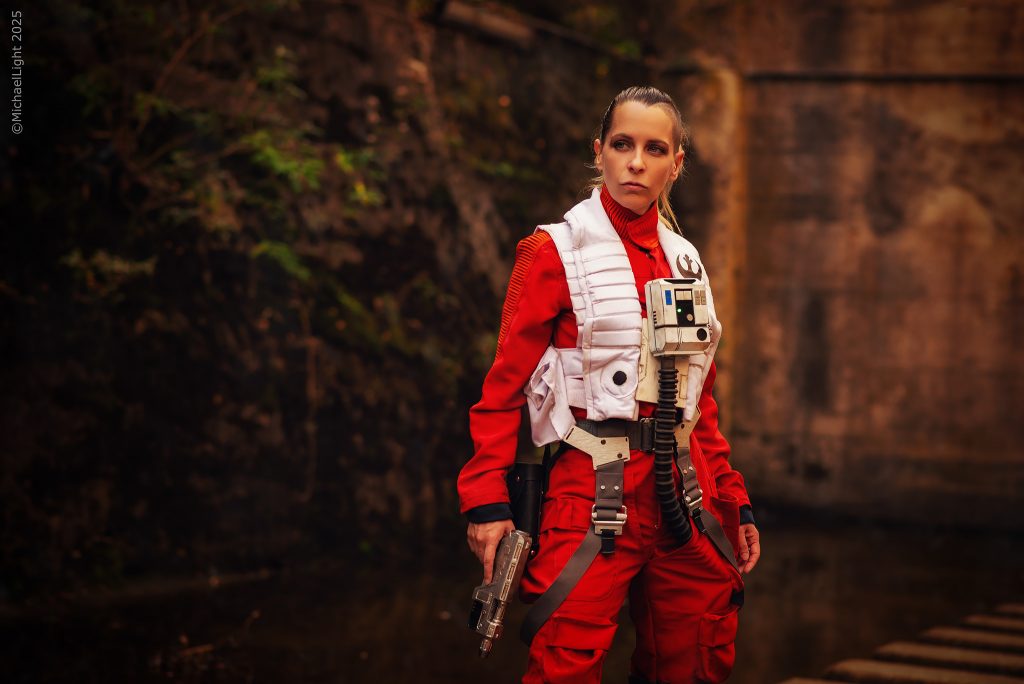
But what does it look like when we want something different? When a set is deliberately built in a studio, with the model shot against a plain grey backdrop and everything else meant to come from Photoshop? When I started out over ten years ago, you either bought a stock photo or spent hours trawling databases of royalty-free images until you found something that worked. Alternatively, you might have known someone, or been able to build a scene yourself in a 3D renderer like Blender. Both were completely accepted before AI came along – nobody seriously debated the artistic merit based on where the background came from. Compositing was considered – and quite rightly so – a creative discipline in its own right. Has that suddenly changed?
Still not convinced? Here are a few more questions worth thinking about: What if the background you bought was generated by AI? What if the Blender project was assembled from purchased 3D models? Is it fine if my third cousin photographed a background at a technology museum, I shot the model in the studio, and the AI composited the layers together?
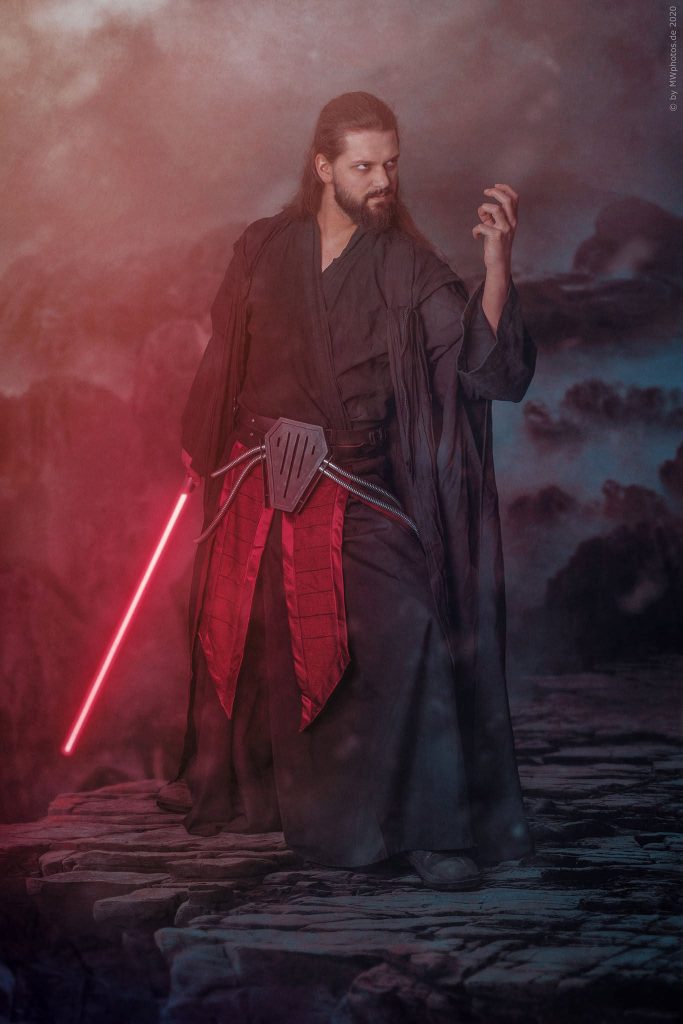
I think at this point you could find endless combinations, each of which could be judged separately – and differently. Maybe the more important question is: What do I actually want to be? A photographer? A retoucher? Is there perhaps even such a thing as the “AI artist”?
For me personally it was always clear – I’m a photo editor. Photos have always been my raw material, and beyond natural portrait work, my real passion is compositing itself – the combining, fitting, lighting, balancing. Matching light and shadow, embedding a character into a scene so convincingly that they genuinely seem to belong there. That’s technically and creatively demanding, regardless of where the individual elements come from. And that, for me, is where the real question lies: not where the material comes from, but what you do with it. Where there’s a creative vision, where decisions are made, where someone is shaping something – that, for me, is art. Where a prompt is fired off and the result is outside my influence, it isn’t.
Final thoughts: engaging with it is worth it – whatever your position
I’m not writing this article to advocate for or against AI. I sit somewhere in the middle: curious, but critical; open, but with clear personal limits when it comes to my own work.
Whatever your view on AI – it’s worth taking a proper look. Not to adapt, not to bury your concerns, but to form an informed opinion. Because blanket rejection without engagement is no more of an answer than blind enthusiasm.
And one more thing: we’re only just at the beginning. What AI can do today is not what it will be able to do in two or five years. The tools will get better, the questions harder, the boundaries blurrier – and many ways of working will change. Anyone engaging with it now – critically, curiously, with their own artistic standards in mind – will be better placed to assess and make use of this development than someone who simply looks away.
Being open to new things doesn’t mean approving of everything. It just means understanding it.
What do you think? Where’s your personal line – and have you tried any AI tools yourself? Feel free to leave a comment or get in touch on social media – I’d love to hear from you!